
Skyscrapers have long been symbols of human ambition. They reach for the sky, not just to impress, but to redefine what architecture can achieve. Modern architects are pushing limits with daring designs, sustainable solutions, and innovative structures that challenge our imagination. Let’s explore 10 skyscrapers that are changing the game.
1. Burj Khalifa – Dubai, UAE
The Burj Khalifa isn’t just the tallest building in the world at 828 meters; it’s a marvel of engineering. Its design was inspired by the Hymenocallis flower and combines Islamic architecture with cutting-edge technology.
-
Height: 828 meters
-
Floors: 163
-
Architect: Adrian Smith
-
Special Feature: Its Y-shaped floor plan maximizes natural light and provides stunning views from every angle.
Fun fact: The exterior cladding is designed to withstand Dubai’s extreme heat while reflecting sunlight to reduce energy consumption ☀️.
2. Shanghai Tower – Shanghai, China
Twisting gracefully into the sky, Shanghai Tower is an example of aerodynamic design. Its spiraling shape reduces wind loads by 24%, making it more stable during storms.
-
Height: 632 meters
-
Floors: 128
-
Architect: Gensler
-
Special Feature: Double-skin glass façade enhances energy efficiency and reduces heating and cooling costs.
People love its sky lobbies—a stunning blend of shopping, green spaces, and observation decks that feel like floating in the clouds 🌿.
3. The Shard – London, UK
London’s iconic glass spire, The Shard, is known for its sharp, jagged silhouette. Inspired by spires of London’s historic churches, it seamlessly blends the old with the new.
-
Height: 310 meters
-
Floors: 95
-
Architect: Renzo Piano
-
Special Feature: Its panoramic viewing gallery offers breathtaking city views, especially at sunset 🌇.
Unlike many skyscrapers, The Shard integrates public spaces, offices, and residences, making it a vertical city.
4. Turning Torso – Malmö, Sweden
This twisting residential tower literally turns as it rises. Inspired by the human body in motion, the Turning Torso is a bold statement in sculptural architecture.
-
Height: 190 meters
-
Floors: 54
-
Architect: Santiago Calatrava
-
Special Feature: Each floor rotates slightly, creating a 90-degree twist from bottom to top.
It’s a perfect example of function meeting art, turning a residential building into a living sculpture 🌀.
5. One World Trade Center – New York, USA
Standing as a symbol of resilience, One World Trade Center combines memorial significance with cutting-edge architecture.
-
Height: 541 meters
-
Floors: 104
-
Architect: David Childs
-
Special Feature: Its design maximizes daylight while maintaining structural strength against natural disasters.
The building’s spire doubles as a lightning rod, literally connecting it to the heavens ⚡.
6. Bosco Verticale – Milan, Italy
Imagine a skyscraper that’s a vertical forest 🌳. Bosco Verticale is covered in over 900 trees and 20,000 plants, improving air quality and urban biodiversity.
-
Height: 111 and 76 meters (two towers)
-
Architect: Stefano Boeri
-
Special Feature: It reduces energy use by providing natural shade and insulation.
This isn’t just architecture—it’s urban ecology in action, proving that cities can grow greener upwards, not just outwards.
7. Petronas Towers – Kuala Lumpur, Malaysia
Once the tallest buildings in the world, the Petronas Towers are famous for their sky bridge connecting the twin towers.
-
Height: 452 meters
-
Floors: 88
-
Architect: César Pelli
-
Special Feature: The sky bridge doubles as an emergency exit and adds structural stability.
The towers reflect Islamic art motifs, blending cultural heritage with modernity 🌙.
8. CCTV Headquarters – Beijing, China
This skyscraper breaks the “straight-up” mold. The CCTV building forms a loop with a cantilevered design, challenging conventional engineering.
-
Height: 234 meters
-
Floors: 44
-
Architect: Rem Koolhaas
-
Special Feature: Its unusual shape reduces internal travel time, connecting offices in a continuous loop.
It’s proof that skyscrapers don’t always need to be vertical to be iconic 🏗️.
9. Marina Bay Sands – Singapore
Marina Bay Sands isn’t just a hotel; it’s an architectural wonder. The three towers are topped by a boat-shaped sky park, a feat of engineering and design.
-
Height: 200 meters
-
Floors: 57
-
Architect: Moshe Safdie
-
Special Feature: Infinity pool on the sky park, offering one of the most famous views in the world 🌊.
It’s tourist-friendly architecture, blending luxury, leisure, and cutting-edge engineering.
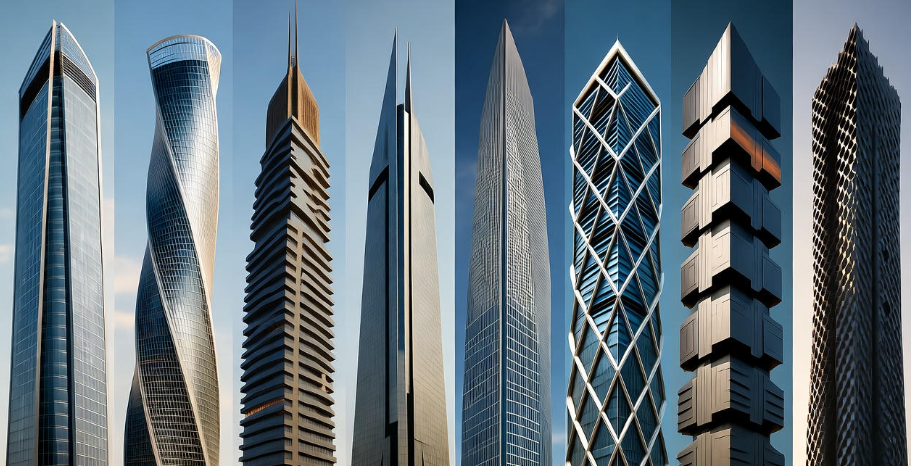
10. Kingdom Tower (Jeddah Tower) – Jeddah, Saudi Arabia (under construction)
Set to surpass the Burj Khalifa, Jeddah Tower promises to redefine skyscraper design. Its sleek, tapering form is designed to withstand harsh desert conditions.
-
Projected Height: 1,000 meters
-
Architect: Adrian Smith + Gordon Gill
-
Special Feature: First building to reach a kilometer high, using high-performance concrete and advanced engineering.
If completed, it will push human imagination to the next level, literally reaching new heights 🚀.
Comparison Table of Skyscrapers
| Skyscraper | Height (m) | Floors | Architect | Unique Feature |
|---|---|---|---|---|
| Burj Khalifa | 828 | 163 | Adrian Smith | Y-shaped floor plan |
| Shanghai Tower | 632 | 128 | Gensler | Twisting design, energy-efficient |
| The Shard | 310 | 95 | Renzo Piano | Panoramic viewing gallery |
| Turning Torso | 190 | 54 | Santiago Calatrava | Twisting residential floors |
| One World Trade Center | 541 | 104 | David Childs | Spire doubles as lightning rod |
| Bosco Verticale | 111/76 | 39/26 | Stefano Boeri | Vertical forest |
| Petronas Towers | 452 | 88 | César Pelli | Sky bridge |
| CCTV Headquarters | 234 | 44 | Rem Koolhaas | Loop-shaped cantilever design |
| Marina Bay Sands | 200 | 57 | Moshe Safdie | Sky park with infinity pool |
| Kingdom Tower | 1,000 | TBD | Adrian Smith | First km-high building (under construction) |
Why Skyscrapers Are Changing Architecture
Skyscrapers today aren’t just about height. They:
-
Embrace sustainability: Green designs reduce energy consumption and air pollution.
-
Blend form and function: Twisting towers, sky gardens, and cantilevered shapes make buildings functional and beautiful.
-
Inspire urban innovation: Vertical forests and sky parks show how cities can grow smartly, not just taller.
These skyscrapers are more than steel and glass; they are statements of human creativity and resilience.
FAQs
Q1: Which skyscraper is the tallest in the world?
A: The Burj Khalifa in Dubai, standing at 828 meters.
Q2: Are twisting skyscrapers more stable than straight ones?
A: Surprisingly, yes. Twisting designs reduce wind loads and improve structural efficiency.
Q3: What is a vertical forest?
A: A vertical forest is a skyscraper covered with plants and trees, like Bosco Verticale in Milan, designed to improve air quality and energy efficiency.
Q4: How do skyscrapers withstand natural disasters?
A: Engineers use deep foundations, flexible materials, and aerodynamic designs to resist wind, earthquakes, and other natural forces.
Q5: Which skyscraper is under construction to surpass the Burj Khalifa?
A: Kingdom Tower (Jeddah Tower) in Saudi Arabia, projected to reach 1,000 meters.