
When we talk about history’s greatest civilizations, Ancient Greece stands proudly at the top. From philosophy to politics and art to architecture — the Greeks shaped the world in ways still visible today. And their architecture? Truly timeless. These structures weren’t just buildings; they were symbols of belief, power, and beauty that defined an entire civilization.
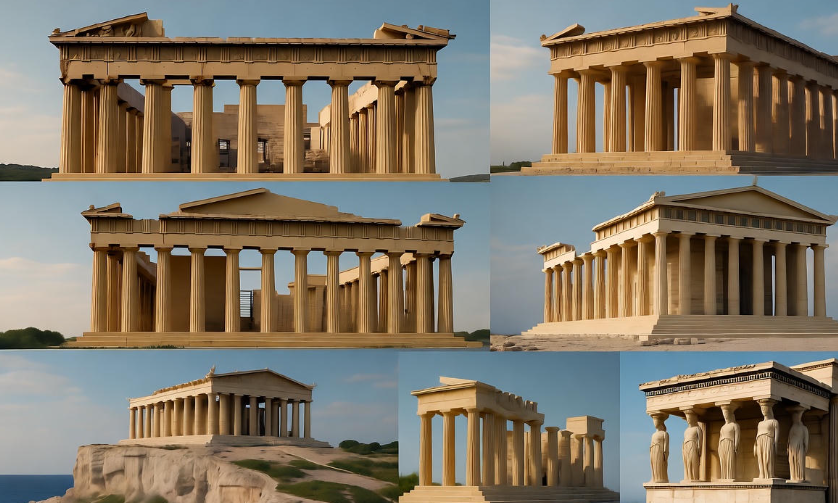
Let’s take a walk (or maybe a stroll through time ⏳) to explore seven of the most iconic architectural wonders of Ancient Greece that continue to inspire awe even after thousands of years.
1. The Parthenon – The Crown of Athens 🇬🇷
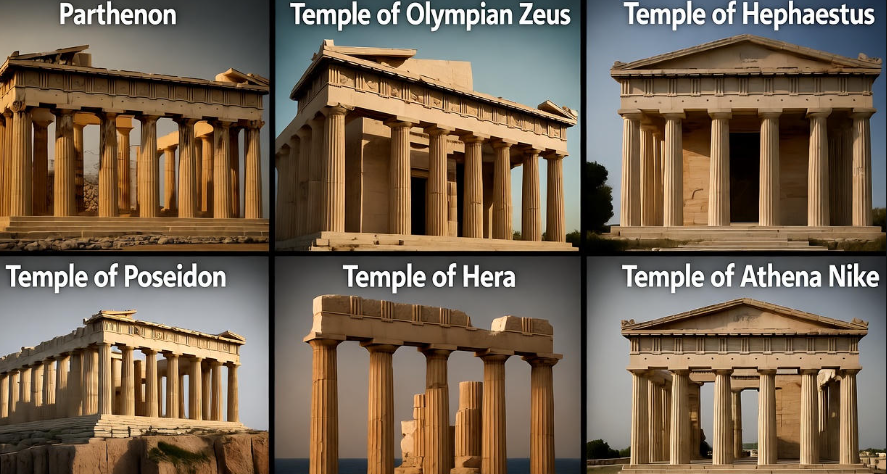
Standing tall on the Athenian Acropolis, the Parthenon is not just a building — it’s a statement. Built in 447 BC and dedicated to Athena, the goddess of wisdom, this temple reflects both Greek devotion and perfection in design. Every column, every curve, was carefully thought out.
What makes it so fascinating is the optical illusion built into its design. The columns aren’t straight — they slightly bulge in the middle (a feature called entasis) to make them appear perfectly straight from a distance. Even modern engineers scratch their heads at such precision.
| Feature | Detail |
|---|---|
| Location | Acropolis, Athens |
| Built | 447–432 BC |
| Material | Pentelic marble |
| Purpose | Temple of Goddess Athena |
Even after centuries of earthquakes, wars, and pollution, the Parthenon still stands — a silent witness to Greece’s golden age.
2. The Temple of Olympian Zeus – A Dream Delayed ⚡
Now here’s a story of ambition. The Temple of Olympian Zeus, or Olympeion, took nearly 700 years to complete. It began under Peisistratus in the 6th century BC but wasn’t finished until Emperor Hadrian took charge in the 2nd century AD.
The temple was enormous — one of the largest in the ancient world. Originally, there were 104 gigantic Corinthian columns, though only 15 survive today. Standing beneath one feels almost humbling, as if you’re staring into history itself.
This temple wasn’t just about Zeus; it was a symbol of Greek endurance — the ability to keep creating, no matter how long it takes.
3. The Erechtheion – The Temple of the Maidens 👩🦰
If the Parthenon represents Greek power, the Erechtheion represents its grace. Built on the same hill, this temple was dedicated to both Athena and Poseidon. What really makes it unique is the Porch of the Caryatids, where six beautifully sculpted female figures act as columns.
Each figure stands with elegance, draped in flowing robes — not just holding up a roof, but embodying timeless beauty. The design reflects the blend of myth and art, something Greeks were absolute masters at.
4. The Theatre of Epidaurus – Where Sound Meets Stone 🎭
Now imagine this: you’re sitting in an open-air theater built more than 2,000 years ago. Someone whispers on stage… and you can hear it perfectly, even if you’re sitting in the very last row. That’s the magic of the Theatre of Epidaurus.
Designed in the 4th century BC, it’s often called the most acoustically perfect theater ever built. The semi-circular layout, limestone seats, and natural surroundings all come together to amplify sound naturally — no microphones, no technology.
| Feature | Detail |
|---|---|
| Location | Epidaurus, Peloponnese |
| Capacity | Around 14,000 people |
| Purpose | Theatrical performances |
| Known For | Exceptional acoustics |
Even today, modern performances are held there, proving that Greek architecture wasn’t just about beauty — it was pure engineering genius.
5. The Temple of Hephaestus – The Best Preserved Wonder 🔨
While many ancient temples have suffered the test of time, the Temple of Hephaestus remains almost perfectly intact. Built around 449 BC, it was dedicated to Hephaestus, the god of fire and craftsmanship.
Its preservation is so remarkable that visitors often mistake it for a modern reconstruction. But no — it’s authentic. Located near the ancient Agora of Athens, this temple shows how simplicity can outlast grandeur.
Its sturdy Doric design and solid foundation protected it from earthquakes and invasions — a perfect example of Greek balance between beauty and durability.
6. The Temple of Apollo at Delphi – The Voice of the Gods 🔮
The ancient Greeks believed Delphi was the center of the world — the place where earth and heaven met. And right at its heart stood the Temple of Apollo, home to the mysterious Oracle of Delphi.
People from across Greece and beyond traveled here to ask questions and receive cryptic prophecies from the priestess known as the Pythia. The temple’s ruins, surrounded by mountains and olive groves, still hold an almost mystical energy.
Interestingly, the temple was rebuilt multiple times due to earthquakes, but it always rose again — like a symbol of eternal connection between humans and gods.
7. The Stoa of Attalos – The Ancient Mall 🏛️🛍️
Here’s something you might not expect — Ancient Greece had its own version of a shopping mall! The Stoa of Attalos, located in the Athenian Agora, was a long covered walkway lined with shops and offices.
It was built around 150 BC by King Attalos II of Pergamon as a gift to Athens. The stoa was both functional and beautiful, with two stories, Doric and Ionic columns, and open public spaces where people gathered to trade, talk, and think.
Reconstructed in the 1950s, it now houses the Museum of the Ancient Agora, reminding us that architecture wasn’t just for gods — it was also for daily life.
Why Ancient Greek Architecture Still Inspires the World 🌍
It’s hard to walk through any major city — from Washington D.C. to Paris — without spotting Greek influence. Columns, pediments, and symmetry — all these elements were born in Greece.
What made Greek architecture so powerful wasn’t just the marble or the math. It was the idea behind it. Every building served a purpose beyond shelter — it reflected philosophy, democracy, and the harmony between man and nature.
A Quick Look: Greek Architectural Styles
| Style | Key Features | Example |
|---|---|---|
| Doric | Simple, sturdy, no base | Parthenon |
| Ionic | Elegant, scroll-like capitals | Erechtheion |
| Corinthian | Decorative, leaf-shaped capitals | Temple of Olympian Zeus |
These styles later influenced Roman, Renaissance, and Neoclassical architecture — shaping everything from cathedrals to government buildings.
Fun Facts You Might Not Know 🤓
-
The Greeks didn’t use cement — their temples were built by interlocking marble blocks.
-
Colors? Yes! Greek temples were originally painted in bright reds, blues, and golds — not the plain white we see today.
-
Each temple faced east so that the morning sunlight would shine directly on the statue of the god inside.
-
The Parthenon was once used as a church, then a mosque, and even as a gunpowder store during war times.
What These Wonders Teach Us Today 💭
The architecture of Ancient Greece wasn’t just about creating something beautiful. It was about expressing values — balance, reason, and harmony. These ideas became the foundation for Western art and design.
Whether it’s the Lincoln Memorial in the U.S. or the British Museum in London, Greek influence runs deep. It reminds us that true greatness doesn’t fade — it evolves, adapting to new worlds while keeping its soul intact.
Frequently Asked Questions (FAQs) ❓
Q1: Why were Greek temples built on hills or elevated land?
Because the Greeks wanted their temples closer to the heavens — symbolically nearer to the gods. Higher ground also made the buildings more visible to the public, showing respect and devotion.
Q2: What materials did Ancient Greeks use for construction?
Mostly marble and limestone. Earlier structures used wood and clay, but marble soon became the favorite due to its strength and beauty.
Q3: How did Greek architecture influence modern buildings?
You can see it in courthouses, museums, and government buildings worldwide — especially in the use of columns, symmetry, and triangular pediments.
Q4: Which is the best-preserved temple in Greece today?
The Temple of Hephaestus in Athens remains the best-preserved ancient Greek temple — almost untouched for over 2,000 years.
Q5: Were all Greek temples religious?
Mostly yes, but they also served as treasuries and cultural centers. Some spaces, like the Stoa of Attalos, were more commercial and social.
Final Thoughts 🌅
Ancient Greece may be long gone, but its stones still whisper stories. Each temple, theater, and stoa tells us something — about human creativity, faith, and the pursuit of perfection. These structures weren’t just made to stand; they were made to speak — to remind us that beauty and logic can coexist.
The seven timeless architectural wonders of Ancient Greece continue to shine as examples of what humanity can achieve when it builds not just with hands, but with heart. 💙