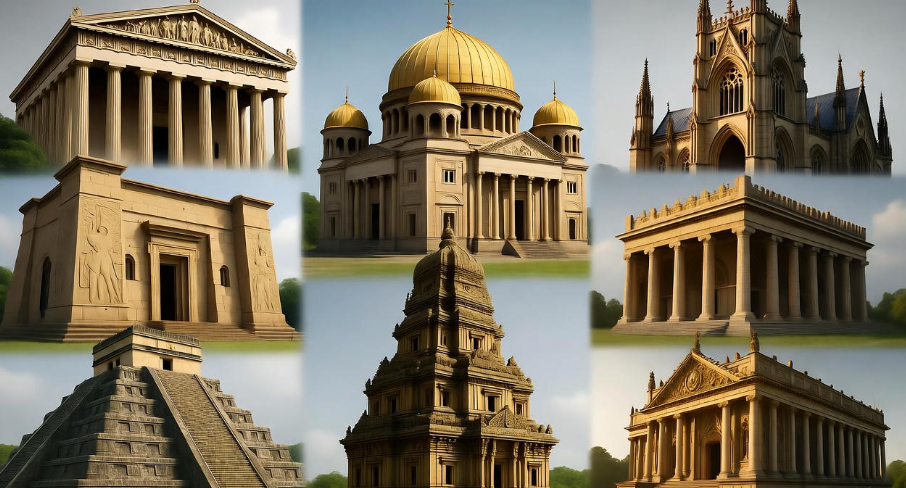

When we talk about ancient architecture, names like the Parthenon or Angkor Wat instantly come to mind. But history hides countless other temples that once stood as marvels of art, science, and human imagination. Some now lie in ruins, buried under centuries of dust, while others quietly remain tucked away in remote corners of the world. These forgotten temples didn’t just serve as places of worship — they shaped the very foundation of architecture and design that we see even today.
Below, we explore eight such temples that redefined ancient design in their own mysterious and fascinating ways.
1. The Temple of Hatshepsut, Egypt 🇪🇬
Built over 3,000 years ago, the Temple of Hatshepsut is an architectural masterpiece carved directly into cliffs near Deir el-Bahari. What makes it so special isn’t just its grand scale but its perfect symmetry and seamless blend with the surrounding desert landscape.
Unlike other Egyptian temples that stood tall and heavy, this one flows horizontally — like it’s growing from the rocks themselves. It introduced the idea of harmony between human creation and nature, a design principle centuries ahead of its time.
| Feature | Description |
|---|---|
| Design Type | Terraced rock-cut structure |
| Key Element | Symmetry & alignment with cliffs |
| Built For | Pharaoh Hatshepsut (the first female pharaoh) |
| Legacy | Inspired later Egyptian and Roman temple designs |
Even today, architects admire its natural integration — proof that ancient builders didn’t just build for power, but for peace and beauty too.
2. The Kailasa Temple, India 🕉️
Hidden in the caves of Ellora, Maharashtra, the Kailasa Temple is one of the most astonishing pieces of ancient architecture ever made. It wasn’t built in the traditional sense — it was carved from a single giant rock.
Think about that for a second. No bricks, no assembly — just one massive stone carved top to bottom. Historians estimate that over 200,000 tons of rock were removed, all without modern tools. The temple honors Lord Shiva and represents Mount Kailash, his heavenly abode.
What makes it revolutionary is its 3D carving approach — a full temple complex, including pillars, corridors, sculptures, and shrines, created from one rock mass.
Fun fact: even modern engineers struggle to explain how this was done with such precision more than 1,200 years ago.
3. The Temple of Borobudur, Indonesia 🌋
Borobudur isn’t just a temple — it’s a story carved in stone. Built in the 9th century during the Sailendra Dynasty, this massive structure is shaped like a mandala — a sacred Buddhist symbol representing the universe.
It’s made up of nine stacked platforms, each filled with intricate carvings that illustrate the path to enlightenment. From afar, it looks like a giant stone mountain rising from the misty jungles of Java.
The design blends Indian, Javanese, and local animist influences — a rare architectural mix that mirrors the spiritual diversity of the time.
| Key Insight | Details |
|---|---|
| Symbolism | Represents the universe in 3D form |
| Material | Volcanic stone blocks |
| Special Feature | 504 Buddha statues and 2,672 relief panels |
| Rediscovered | 1814 by Sir Thomas Raffles |
This temple redefined how sacred geometry could be turned into living architecture — a balance between physical and spiritual design.
4. The Temple of Artemis at Ephesus, Turkey 🕊️
Once considered one of the Seven Wonders of the Ancient World, the Temple of Artemis stood as a masterpiece of Greek design and engineering. Sadly, it exists now only in fragments — but its influence never died.
Built in 550 BCE, it was one of the largest temples ever constructed in the ancient Greek world. The temple’s beauty came from its proportions — columns taller than 60 feet, made entirely of marble, and decorated with exquisite carvings.
Even its destruction couldn’t erase its mark. Later Roman and Renaissance architects borrowed its column layout and symmetry for cathedrals and government buildings.
Though forgotten by time, the Temple of Artemis laid the foundation for classical architecture — where balance, order, and beauty became inseparable.
5. The Temple of Baalbek, Lebanon 🏺
Nestled in the Bekaa Valley, Baalbek’s temple complex is one of the largest and most mysterious Roman temple sites in existence. The stones used here are gigantic — some weighing more than 1,000 tons.
No one knows exactly how these were moved or lifted. The design of Baalbek combines Roman precision with older Phoenician and Greek influences, making it a cultural fusion like no other.
| Element | Description |
|---|---|
| Location | Baalbek, Lebanon |
| Key Structures | Temple of Jupiter, Temple of Bacchus |
| Stone Blocks | Trilithon stones (800–1000 tons each) |
| Mystery | Advanced stone-cutting and alignment techniques |
The temple’s grandeur was unmatched — tall columns, intricate carvings, and astronomical alignments that hint at forgotten engineering brilliance.
6. The Temple of the Inscriptions, Mexico 🐍
Deep in the forests of Chiapas, the Mayan city of Palenque hides one of its greatest treasures — the Temple of the Inscriptions. It was not just a place of worship but also a royal tomb.
What makes this temple stand out is its engineering intelligence. It’s designed with hidden passages, air vents, and stairways leading deep underground. The temple tells the story of King Pakal, whose sarcophagus was found buried beneath it.
The carvings on the walls depict cosmic stories — the creation of the world, the gods, and the journey of the soul.
This temple redefined Mesoamerican design by combining religion, astronomy, and architecture into one breathtaking structure.
7. The Temple of Philae, Egypt 🌅
Dedicated to the goddess Isis, the Temple of Philae was once located on Philae Island before it was moved to nearby Agilkia Island to save it from flooding during the construction of the Aswan Dam.
Philae was one of the last ancient temples built in the classical Egyptian style, showing a blend of Pharaonic and Greco-Roman design. Its delicate carvings, slender columns, and peaceful location on the Nile made it one of the most photogenic temples of all time.
The temple’s relocation in the 20th century was a major archaeological effort — and it symbolized how even ancient design can survive the test of both time and technology.
8. The Temple of the Sun, Peru ☀️
At the heart of the Incan capital Cusco once stood the Temple of the Sun, also known as Coricancha. It was the most important temple in the Incan Empire, dedicated to Inti, the Sun God.
The walls were once covered with sheets of gold that reflected the sunlight brilliantly — turning the temple into a glowing monument.
The structure showcased the Incas’ mastery of stonework. Each block was carved so precisely that they fit together without mortar. Even earthquakes couldn’t shake them apart.
| Aspect | Detail |
|---|---|
| Built By | Inca Civilization |
| Purpose | Worship of Sun God (Inti) |
| Special Feature | Gold-covered walls and perfect stone fitting |
| Legacy | Inspired modern seismic-resistant architecture |
When the Spanish arrived, they built a church over it — yet the original Inca foundations still stand stronger than the colonial structures above.
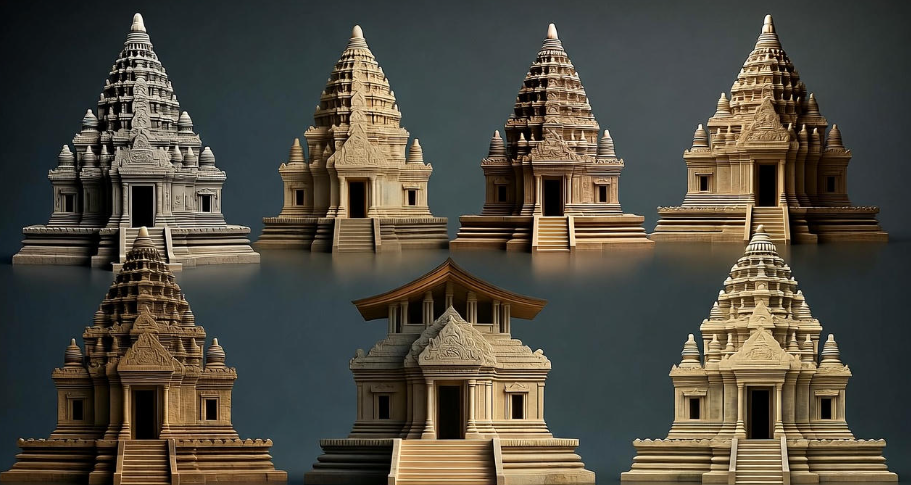
A Quick Comparison Table: Architectural Highlights of the 8 Temples
| Temple | Civilization | Unique Design Feature | Influence |
|---|---|---|---|
| Hatshepsut | Egyptian | Carved into cliffs | Blending nature with design |
| Kailasa | Indian | Rock-cut monolith | Precision stone engineering |
| Borobudur | Indonesian | Mandala structure | Symbolic architecture |
| Artemis | Greek | Perfect marble symmetry | Foundation for classical style |
| Baalbek | Roman-Phoenician | Massive stonework | Engineering mystery |
| Inscriptions | Mayan | Hidden tomb & passages | Symbolic cosmology |
| Philae | Egyptian-Greco | Relocation success | Preservation architecture |
| Sun Temple | Incan | Gold & precision fit | Earthquake-resistant design |
Why These Temples Still Matter Today
These forgotten temples are more than ruins — they’re lessons in how ancient minds thought about beauty, space, and connection to nature. They remind us that architecture was never just about building walls — it was about telling stories through stone.
Each structure introduced something new: rock-cut carving, perfect geometry, environmental harmony, or astronomical alignment. Many of today’s architects still draw inspiration from them, often unknowingly.
Frequently Asked Questions (FAQs) 🤔
Q1. Why are these temples called “forgotten”?
Because many of them were buried, destroyed, or hidden for centuries — rediscovered only through modern archaeology. They didn’t receive the same fame as temples like the Parthenon or Angkor Wat but were equally or even more innovative.
Q2. Which of these temples is the oldest?
The Temple of Hatshepsut in Egypt is among the oldest, dating back to around 1470 BCE.
Q3. Are any of these temples still open to visitors?
Yes! Temples like Borobudur (Indonesia), Kailasa (India), Philae (Egypt), and Baalbek (Lebanon) are open to tourists and history lovers.
Q4. What design principles from these temples are used today?
Symmetry, natural integration, precise geometry, and earthquake-resistant structures — all have roots in these ancient designs.
Q5. What’s the most mysterious among them?
The Kailasa Temple at Ellora stands out. Its single-rock carving method still puzzles modern engineers and historians alike.
Final Thoughts 🌍
The ancient world wasn’t just about survival — it was about creativity, vision, and pushing the limits of what was possible. These eight forgotten temples prove that innovation is timeless.
They remind us that even in silence, stone speaks — telling stories of devotion, discovery, and design genius that continue to inspire humanity thousands of years later.