

Hidden deep in the rugged mountains of southern Jordan lies a masterpiece of human creativity — the Lost City of Petra. Once a bustling trade hub carved straight into rose-red cliffs, Petra is not just a city; it’s a living testimony to human intelligence, determination, and artistry. Many people visit it today for its beauty, but few truly understand the incredible architectural genius that made it possible over two thousand years ago.
Let’s dive into what made Petra such a breathtaking architectural achievement — and why it still leaves engineers, historians, and travelers in awe.
The Origin Story of Petra 🌄
Petra was the capital of the Nabataean Kingdom around the 4th century BCE. The Nabataeans were an ancient Arab people who mastered desert living. Unlike other civilizations that relied on fertile lands or rivers, they thrived in the middle of a harsh desert. What made this possible was their deep understanding of nature, water, and stone.
They didn’t just build on land — they built into it. Every temple, tomb, and monument was carved from the natural sandstone cliffs. This was not only practical but also symbolic. The color of the rock changed with sunlight, giving Petra its nickname: The Rose City.
Engineering Brilliance: Carving a City from Stone ⛏️
Imagine carving an entire city without modern tools — no cranes, no machinery, not even iron chisels for most of it. The Nabataeans managed this by using simple yet precise tools, often made of bronze or iron, to chip away at sandstone.
They started from the top of the rock face and carved downward. This method prevented debris from damaging the lower parts of their work. It’s like sculpting an entire building upside down — a process that required extraordinary skill and planning.
Each structure was measured carefully to maintain perfect symmetry, even when carved directly into a mountain. Archaeologists still debate how they achieved such precision with basic tools, but it’s clear the Nabataeans combined mathematics, geometry, and artistic vision in a way few ancient cultures ever did.
The Water Management System: A Desert Miracle 💧
One of the most fascinating parts of Petra’s architecture wasn’t just the buildings — it was the water system. You see, Petra was located in a desert valley that received little rainfall. Yet the Nabataeans turned it into a thriving green city through innovation.
They created a complex network of:
| Feature | Function |
|---|---|
| Dams | Collected seasonal rainwater from nearby mountains |
| Cisterns | Stored water underground to prevent evaporation |
| Clay pipes | Transported water across the city |
| Channels | Controlled the water flow and reduced flooding |
What’s impressive is that this system could supply water all year round — enough for drinking, bathing, and agriculture. It was so efficient that even modern engineers marvel at how sustainable it was.
This mastery over water made Petra more than just a city — it was an oasis engineered by visionaries.
Architectural Styles and Cultural Blending 🏛️
Petra’s architecture isn’t purely Nabataean. That’s what makes it so special. The city sat at the crossroads of several major trade routes — connecting Arabia, Egypt, Greece, and Rome. Because of this, its buildings reflect a fusion of different cultures.
For example:
-
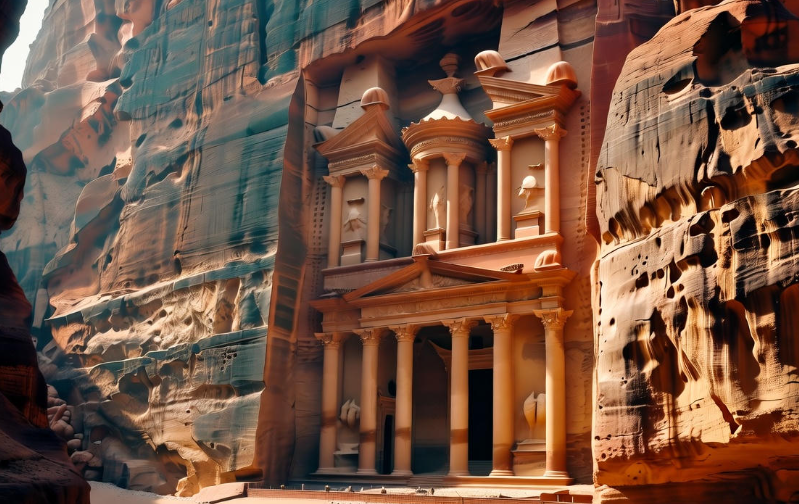
The Al-Khazneh (The Treasury) has Greek-style columns and Egyptian-inspired decorations.
-
The Monastery (Ad Deir) shows Roman influences with its grand facades and symmetrical layout.
-
Local Nabataean touches are found in the rock carvings and internal layouts, reflecting their own traditions.
This mix of influences makes Petra a living museum of ancient architectural collaboration. It’s a reminder that great civilizations often borrow, adapt, and innovate together.
Symbolism in Petra’s Design 🧩
Petra wasn’t just practical — it was deeply spiritual. Many buildings served religious or ceremonial purposes. The Treasury, for instance, wasn’t really a treasury; it’s believed to have been a royal tomb or temple.
The city’s layout itself may have been symbolic. Archaeologists suggest that certain buildings align with celestial events like solstices. When the sun hits specific spots, it illuminates parts of temples — possibly as part of ancient rituals.
So, the Nabataeans didn’t just build for function; they built with meaning. Every curve, line, and carving had a story.
The Hidden Acoustics of Petra 🎶
One of Petra’s lesser-known marvels is its natural acoustics. The amphitheater, carved into rock, could seat over 3,000 people. And because it was shaped in harmony with the surrounding cliffs, sound could travel perfectly across the entire space without amplification.
This shows how advanced their understanding of sound and structure was. The Nabataeans were not just architects — they were engineers, artists, and scientists all in one.
Resilience Through Design 🧱
Sandstone may look delicate, but Petra’s structures have survived earthquakes, wind, and time itself for more than two millennia. How? Because the Nabataeans knew their material well.
They carved buildings in such a way that the natural layers of sandstone acted as reinforcement. In modern terms, it was like designing with built-in shock absorbers. The thickness of walls and depth of carvings were chosen specifically to prevent collapse.
Even after centuries of erosion, much of Petra remains standing — a tribute to the intelligence of its builders.
Modern Lessons from Ancient Genius 🌍
Petra isn’t just a wonder of the past. It offers lessons for modern architects and city planners. For instance:
| Lesson | Modern Relevance |
|---|---|
| Sustainable water use | Cities today face droughts; Petra shows how to save and manage water effectively. |
| Natural material use | Building with local resources reduces cost and environmental harm. |
| Integration with nature | Petra blends into its surroundings rather than destroying them. |
| Cultural openness | The Nabataeans proved that mixing styles creates timeless beauty. |
If we applied even a fraction of Petra’s wisdom, modern urban design could become much more sustainable and harmonious with nature.
Rediscovery and Legacy 🕰️
For centuries, Petra was lost to the world — hidden under sand and stories. In 1812, Swiss explorer Johann Ludwig Burckhardt rediscovered it. What he saw was beyond imagination — a city carved into mountains, silent but majestic.
Today, Petra is a UNESCO World Heritage Site and one of the New Seven Wonders of the World. It attracts millions of visitors each year who come not only for its beauty but to witness a civilization that defied nature itself.
Why Petra Still Matters ❤️
Petra is more than a tourist attraction. It’s a message from history, reminding us what humans can achieve with creativity and respect for the environment.
When you stand before the Treasury, glowing golden in the morning light, you’re not just looking at stone — you’re looking at intelligence frozen in time. It’s proof that architecture isn’t about tools or technology, but vision and understanding.
Even after thousands of years, Petra continues to whisper the same truth: that art, science, and nature are strongest when they work together.
FAQs about the Lost City of Petra 🧭
Q1: Who built the city of Petra?
Petra was built by the Nabataeans, an ancient Arab tribe known for their trade and advanced engineering skills.
Q2: Why is Petra called the “Rose City”?
Because the sandstone cliffs it’s carved from glow in pinkish-red shades, especially at sunrise and sunset.
Q3: What is Petra’s most famous building?
The most famous structure is Al-Khazneh (The Treasury) — an enormous temple-like tomb carved into the rock face.
Q4: How did Petra get water in the desert?
Through a smart system of channels, dams, and underground cisterns that stored rainwater and guided it through the city.
Q5: Is Petra still inhabited today?
While no one lives in the ancient structures anymore, nearby Bedouin communities still care for the site and share their heritage with visitors.
Q6: How long did it take to build Petra?
Historians estimate it took several centuries, as structures were carved and expanded gradually over generations.
Q7: What can modern architects learn from Petra?
They can learn the importance of sustainability, natural integration, and adapting architecture to the environment rather than forcing it.
Final Thought 🌅
Petra isn’t just an ancient wonder — it’s a masterclass in design, resilience, and balance. The Nabataeans didn’t conquer nature; they cooperated with it. Their architecture was a conversation between stone and spirit, between the harshness of the desert and the softness of human imagination.
So, next time you see a photo of Petra’s glowing facade, remember this: it’s not just a ruin. It’s a dream carved into reality — one that still speaks across time.