
How Stonehenge Was Built by Hand
Erected high on England’s Salisbury Plain, Stonehenge has mystified historians, archaeologists and visitors alike for centuries. Here, these huge stones are arranged in a circle that can appear almost impossible to make with the rudimentary tools and machinery available thousands of years ago. Yet our forebears constructed it with nothing more than their hands, basic tools and awesome will. How did they do it? So let’s take a look at some of the intriguing theories and findings that help to explain this fantastic feat.
The Giant Rocks That Began an Era
Before we can understand how Stonehenge was built, we need to consider what builders had to work with. The monument consists of two types of stones, both with their own set of challenges.
The Sarsen Stones: Local Giants
The big rocks at Stonehenge are sarsen stones. These blocks of gray sandstone are enormous. The largest ones weigh up to 25 tons— that’s as massive as four grown elephants! They are about 30 feet tall, with a large part of each post underground to keep it steady. There are 83 such stones altogether, although not all have survived to last even to this day.
Those sarsen stones are thought to have been transported from West Woods in Wiltshire, which is some 15 miles north of the site. Fifteen miles may not sound like much today, but picture moving a 25-ton rock that far without wheels or trucks or cranes. It would have been an extraordinarily difficult operation that hundreds of people would have worked on.
The Bluestones: Travelers From Afar
The smaller stones, called bluestones, are an even greater mystery. These are 2-to-5-ton (jaw-droppingly heavy) rocks, made of a spotted dolerite. Their magic is in where they’re from: the Preseli Hills in Wales, some 150 miles from Stonehenge.
Why in the world would ancient builders bring stones from so far? Some scientists suspect that the bluestones may have had special spiritual or healing properties. The extraordinary labor involved in bringing them suggests that they were more than just common building materials — they were sacred things worth the long haul.
| Stone Type | Weight | Place of Origin | Distance | Quantity |
|---|---|---|---|---|
| Sarsen Stones | Up to 25 tons | West Woods (Wiltshire) | ca. 15 mi. (ca. 24 km) | 83 |
| Bluestones | Between 2 and 5 tons | Preseli Hills (Wales) | ca. 150 mi (ca. 241 km) | 80 |
The Tools of the Trade That Enabled It
The people who constructed Stonehenge lived during the Neolithic period, or New Stone Age. They had no metal tools and no power drills or anything that would even pass for modern equipment as we know it. Instead, they used instruments created from substances occurring naturally.
Antler Picks: Nature’s Excavators
The antlers of red deer were used as picks to excavate below ground. These antler picks occur in their hundreds at Stonehenge. When antlers are fresh, they’re remarkably strong and can pierce through chalk or soft rock. Workers used them to break up the earth and form the holes in which stones would be placed.
Stone Hammers and Mauls
The builders used hard stones, such as sarsen and granite, for pounding and shaping the softer ones. By hammering the same spot on a stone over and over, they could chip away at it to make smoother surfaces or specific shapes. This process, known as pecking, was slow and required skill. Some of the stones at Stonehenge reveal tens of thousands of tiny marks where workers wielded their hammers in the same spot for weeks or months.
Wooden Tools and Levers
In the construction, wood was key. The heavy oak beams could be employed as levers to lift and shift stones. Wooden rollers or sleds could have aided in moving large stones across the flat terrain. Sadly, wood rots and we don’t have very many extant examples. But archaeologists have discovered post holes and impressions in the ground which appear to indicate the presence of large wooden structures during its construction.
Rope Made From Natural Fibers
Tough ropes were necessary to drag and manage the great stones. Ancient peoples used plant fiber, strips of leather and animal sinew to make rope. One rope may seem flimsy, but braid a dozen or a hundred together and the result is cables capable of carrying huge loads. There is evidence that rope-making was an advanced industry at this time.
Moving Mountains: How the Stones Were Transported
Getting the stones to Stonehenge was probably one of the most difficult aspects for builders. Scientists and archaeologists have formulated a few ideas using experimental archaeology — when modern people attempt to replicate ancient procedures.
The Sledge and Roller Method
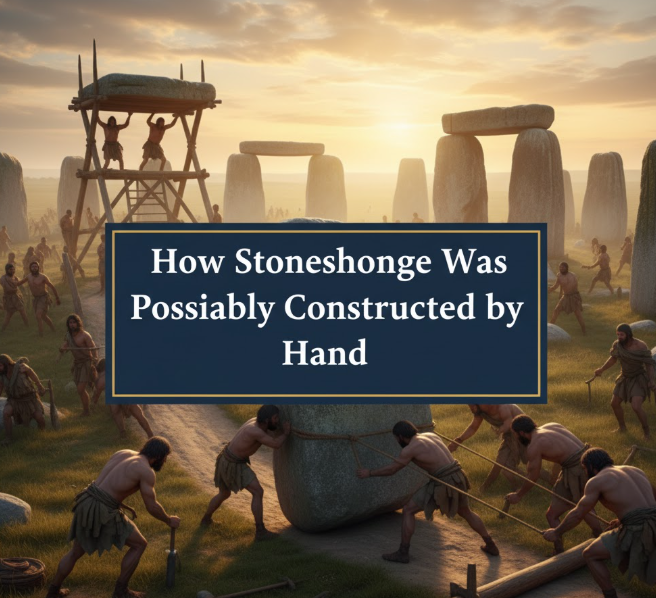
The prevailing theory today is that they were dragged on wooden sledges. Here’s how it probably worked:
Workers would first affix a stone to a robust wooden platform or sledge. This sled would then be positioned on wooden rollers—basically, round logs laid beside one another. The sledge would be pulled over the rollers.
The challenge? It would roll off the rear rollers as it moved ahead. You would have to keep stopping and picking up those rear rollers and putting them back in front. This took coordination, communication and a lot of people working together in perfect time.
In 2012, a group of volunteers were able to drag a 40-ton concrete block in this way. It took 100 people or so working together, but they showed it could be done. For the heaviest stones at Stonehenge, builders may have required 200-300 individuals working together.
The Water Route Theory
For the bluestones originating in Wales, some archaeologists suspect workers employed a mix of land- and water-based transport. The stones might have been loaded onto rafts or boats and hauled along the Welsh coast, then up rivers to Salisbury Plain. This would have been far easier than hauling stones over hills and dales some 150 miles.
However, this theory has critics. Some say old vessels couldn’t have carried safely such heavy stones. Others note that rivers don’t connect directly to Stonehenge, so moving must have been made overland most of the way. The debate continues today.
The Grease and Track System
Another interesting idea is that builders formed tracks with wood and greased them with animal fat. Stones transported on sledges could be drawn more readily over these smooth surfaces. Experiments suggest that grease can cut friction in half, which would require fewer workers to move every stone.
There is also archaeological evidence that ancient humans made extensive use of animal fat, and they likely had access to it. Whether or not they used it to move stones remains a mystery.
Raising Giants: Erecting the Stones
Once the stones reached the construction site, the next challenge was getting them to stand upright. This took careful planning, extraordinary strength and cunning deployment of basic physics.
Digging the Stone Holes
First, workers dug deep pits with their antler picks and stone shovels. These weren’t just any holes — they were deliberately designed. Each pit had one side that was slanted and the other that was vertical. This pattern was important for what followed.
The holes were deep — 8 feet down for the tallest stones. They had to be deep enough to handle the enormous weight without allowing the rock to tip over. Ancient builders were more exacting than we thought. Also, the holes are nearly exactly where they should be, indicating precise measurement and planning.
The Tipping Process
When a pit was prepared, workers would pull a stone until its base extended over the edge of the hole. They situated it in such a way that the stone would drop into the hole on one of its sloped sides. Then came the difficult part: getting the stone from horizontal position to upright.
Teams used wooden levers and A-frame structures to slowly lift the top of the stone up. When it rose up, they pushed the base farther into the hole. Think dozens of men, each one straining to push the huge stone up centimeters at a time using long wooden poles. It would have taken them hours, if not days, to raise a single stone.
Securing and Packing
Once a stone was standing upright in its hole, workers had to ensure that it wouldn’t topple over. They packed the cavity tightly with small stones and chalk. They also put earth into the hole, tamped firmly about its base. Some stones were set so precisely that they’ve remained in exactly the same place for 4,500 years.
The builders’ precision is astounding. The stones are not simply upright, but aligned with astronomical phenomena such as the summer solstice sunrise. It took more than just brawn to hit such an accurate mark—it required a sophisticated grasp of mathematics and astronomy.
Constructing the Stone Circle: Joining the Dots
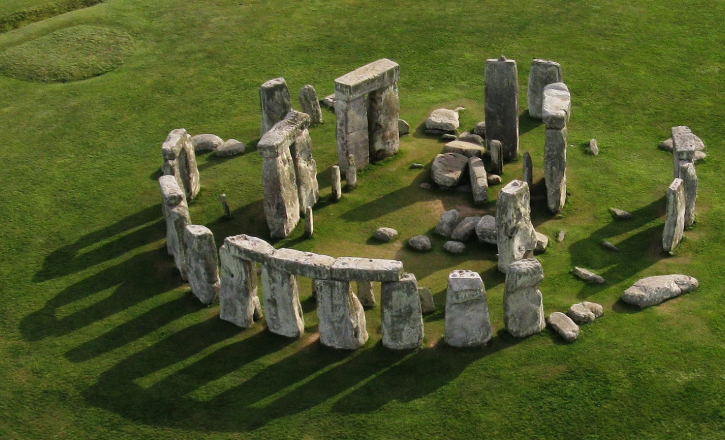
Stonehenge isn’t just standing towers of stone — it’s an engineered structure with horizontal slabs sitting on top of the uprights in predetermined positions. These horizontal stones, known as lintels, form the classic circle shape that we see today.
Shaping the Lintels
Each lintel had to be cut to fit over two vertical stones. The builders employed their stone hammers for two kinds of joints:
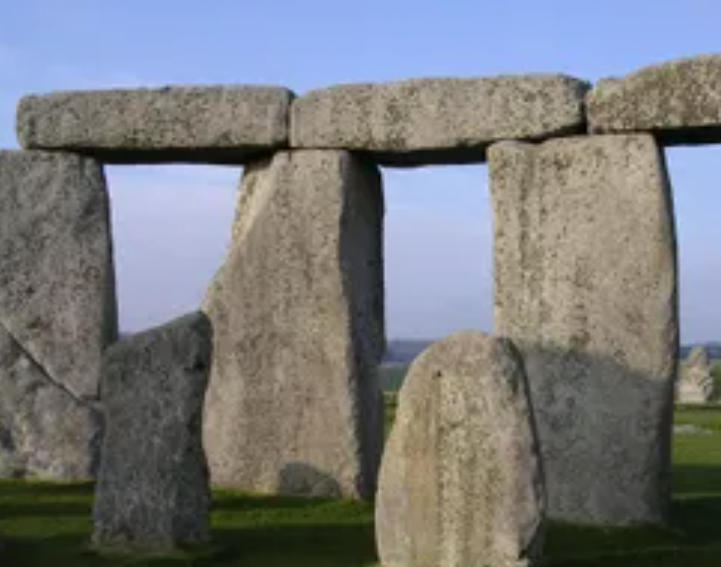
Mortise and tenon joint: They carved bumps (tenons) on the top of upright stones and corresponding holes (mortises) on the underside of lintels. This made it so that the lintels couldn’t slip.
Tongue and groove joints: To join each of the lintels at their crown, they were shaped so that one would fit snugly into another like a puzzle piece.
These joints reflect a high degree of carpentry applied to masonry. It’s an approach from woodworking, applied to materials weighing several tons.
Raising the Lintels
How could they have lifted the 10-ton lintels 16 feet up? The most probable method must have been by means of a temporary wooden stage or ramp. Here’s the probable process:
Workers would build a wooden crib — layers of timber stacked log-cabin fashion next to the standing stones. They would place the lintel on this platform, and use levers to lift it up, adding a layer of timber underneath. Lift, add some timber, lift, add more timber — raising the stone bit by bit until it sat at the top of the uprights.
They’d get the lintel to just the right height, then slowly slide or lever it into place, ensuring that those mortise-and-tenon joints made a snug fit. Then they would take the wooden structure down and proceed to the next lintel.
The Workforce Behind the Wonder
Who actually built Stonehenge? For so long, people imagined enslaved workers under cruel conditions. Modern archaeology has a different story to tell.
A Community Effort
The evidence indicates that Stonehenge was built by different communities collaborating, potentially as volunteers in the service of a religious movement. Archaeologists have discovered evidence of large feasts near the construction site, with remains from pigs, cattle and other animals. These were not scraps of leftovers — these were quality meat cuts, suggesting that workers received a healthy diet.
Excavations recently found a large settlement near Stonehenge at a site known as Durrington Walls. This settlement was home to hundreds and possibly thousands of inhabitants during the time of its construction. Evidence indicates that they had comfortable houses and abundant food.
Specialized Skills
The workers who built Stonehenge were not all of the same type:
- Stone carvers: Skilled workers who knew how to handle and shape stone exactly
- Engineers: Those who understood leverage, balance and stability
- Rope workers: Experts in making the heavy-duty cordage required to pull stones
- Carpenters: Makers of the wooden tools and structures
- Coordinators: Community leaders who organized hundreds to work in concert
- Laborers: The multitudes who hauled rope, dug holes, and provided muscle
This wasn’t random chaos — it was organized, planned work that took coordination across many teams.
The Timeline: Building in Stages
Stonehenge wasn’t constructed in a day. Archaeological evidence indicates that construction took place over some 1,500 years in several distinct phases.
Phase 1 (c. 3000 BCE): The Earth Circle
The original Stonehenge wasn’t built of stone at all. People erected a circular ditch and bank, along with wooden posts placed in regular patterns. This early structure was mostly an earthwork—a sacred place defined more by shaped earth than stone buildings.
Phase 2 (circa 2500 BCE): The Bluestones Arrive
Roughly 500 years later, the Welsh bluestones were transported to the site and arranged. Precisely how they were initially set is unclear as later building destroyed this earlier work.
Phase 3 (c. 2400-2200 BCE): The Sarsen Circle
This is when Stonehenge took the form we know today. Builders hauled the huge sarsen slabs from West Woods and stood them up in the familiar circle, complete with lintels. They also built the horseshoe arrangement of five massive trilithons in the center.
Later Modifications
Even after the primary construction, people modified Stonehenge. They moved the bluestones around, set them up in new combinations and shifted positions. The site retained significance for at least 1,000 years more.
| Time Period | Phase | Summary Features |
|---|---|---|
| 3000 BCE | Phase 1 | Circular ditch and bank, wooden structures |
| 2500 BCE | Phase 2 | Bluestones transported from Wales |
| 2400-2200 BCE | Phase 3 | Sarsen circle erected, trilithons added |
| 2200-1600 BCE | After main construction | Rearranging stones, modifications |
Why the Extraordinary Effort?
Stonehenge took thousands of hours to build, required hundreds of people working together and significant resources. Why would people in ancient times take such trouble?
An Astronomical Calendar
Stonehenge is aligned with significant astronomical phenomena, including the summer and winter solstices. On the summer solstice, the sun rises over the Heel Stone when viewed from the center of the monument. This wasn’t a coincidence; it was intentionally designed this way by its builders.
Early farming communities had to keep an accurate count of the seasons in order to plant crops and prepare for winter. Stonehenge might have been used as a massive calendar to mark key dates and festivals throughout the year. Learn more about ancient astronomical observatories and their significance in early civilizations.
A Sacred Gathering Place
It appears that people came from all over Britain to visit Stonehenge, particularly during major astronomical events. The monument may have been a pilgrimage center — a site where groups of people would converge for religious rituals, festivities and communal celebration.
Honoring the Ancestors
Cremated human remains have been discovered at Stonehenge, indicating the site acted as a cemetery for some of Britain’s early important people. Some researchers think it was a place to celebrate ancestors and maintain connection between the living and the dead.
A Symbol of Unity
Most significantly, constructing Stonehenge would have forced different communities to unite and work toward a common purpose. The very act of building itself—transporting stones from afar, cooperating on difficult tasks—may have encouraged different groups to join together into a larger society.
Modern Experiments: Testing Ancient Methods
Today’s archaeologists don’t just theorize about how Stonehenge was built—they test their ideas with experiments.
The 2012 Moving Stone Experiment
In England, engineers and volunteers succeeded in moving a 40-ton concrete block one kilometer using only Stone Age techniques. The team used ash logs, oak sledges and hemp rope. On level terrain, approximately 130 people could transport the stone at about one kilometer per hour.
This experiment demonstrated that ancient methods work, but it also showed how difficult they can be. Many more people were required when going uphill. Replacing rollers constantly was exhausting. It required practice and leadership to organize everyone to pull at the same time.
Raising Stone Experiments
A number of teams have experimented with raising multi-ton stones using only wooden levers, ramps and manpower. These experiments demonstrate that while the work was challenging, it was certainly doable with enough people and good organization.
What’s astonishing is just how much skill was involved. Contemporary humans using ancient tools failed at first, but grew more efficient with practice. The people who built Stonehenge had decades or generations of accumulated knowledge, and they were very good at it.
The Mysteries That Remain
Although there’s been a great deal of research, some questions about how Stonehenge was built remain unanswered.
How Did They Achieve Such Precision?
There is remarkable precision to the placement of the stones. How did builders measure and align the blocks with such accuracy in an age without modern surveying equipment? They must have had sophisticated methods—unfortunately we don’t fully understand them yet.
Where Did the Wooden Structures Go?
We have evidence of extensive use of wood during building, but relatively little has been found in terms of remains. What really did these structures look like? How were they built? We know little because wood doesn’t last thousands of years.
Why These Specific Stones?
Why were bluestones hauled 150 miles when suitable stones could be found much nearer? There has to be a special reason for it—though so far, we can only speculate. Maybe these stones held some kind of spiritual significance or perhaps they came from another sacred site that people wanted to connect with Stonehenge.
What Stonehenge Teaches Us Today
The building of Stonehenge shows that our ancestors were remarkably capable, even without modern technology. They accomplished something impressive thousands of years before we had advanced tools.
Human Cooperation and Organization
Stonehenge demonstrates that ancient people could coordinate construction projects of significant complexity—projects that required hundreds to work together for decades. This degree of social coordination reflects sophisticated leadership, communication, and shared purpose.
Innovation and Problem-Solving
Confronted with overwhelming obstacles, Stone Age people devised clever solutions. They understood leverage, weight distribution, friction and engineering principles — even without writing or mathematics as we know it.
Patience and Persistence
Building Stonehenge took generations. Work was undertaken with the realization that one might not survive to see it finished. This kind of long-term thinking and readiness to work for goals far in the future is still inspiring today.
Respecting the Past
Stonehenge teaches us to respect ancient peoples and the ways they shaped the world. These were not primitive people with simple minds who could accomplish only basic tasks. They were highly intelligent, creative problem-solvers working with different tools at a different time in history.
Frequently Asked Questions
How old is Stonehenge and how long did it take to build?
The entire construction was carried out in stages over the course of about 1,500 years, from around 3000 BCE to 1600 BCE. The primary stone circle we know today was built over several decades—perhaps 200 or even 300 years.
How many people were required to construct Stonehenge?
Estimates differ, but the heaviest stones would have needed around 200–300 people to move. The total workforce varied during different periods of construction and might have included 1,000-4,000 people: some moving stones, others preparing food, and others producing tools or building temporary structures.
Could a single person have built Stonehenge?
No, there was no way to do that physically. Stones weighing many tons simply could not have been moved, positioned, or raised by an individual even with our modern knowledge of physics and engineering. Stonehenge was very much a communal monument that required many people working together.
How did ancient people move stones without wheels?
The wheel had been invented in other parts of the world, but it either hadn’t reached Britain yet or the terrain around Stonehenge wasn’t suitable for wheeled transport. Soft, uneven earth would have caused wheels to sink and get stuck. Sledges and rollers actually worked better in many cases.
Are there other stone monuments constructed in similar ways?
Yes! There are stone circles and megalithic monuments all over Europe and in other parts of the world. Places like Avebury (also in England), the stone circles of Orkney in Scotland, and even the famous statues of Easter Island were all made in similar ways: people power, basic tools, and clever engineering.
Were aliens or advanced technology responsible for building Stonehenge?
There is no credible archaeological evidence to support these claims. Everything we have discovered indicates that Stonehenge was built by ordinary human beings using simple tools along with abundant hard work. Experiments demonstrating that these approaches work render alternative explanations unnecessary. Claiming aliens made it actually diminishes the amazing accomplishments of our ancestors.
How much do we really know about how Stonehenge was built?
Although we have good evidence for many aspects of construction, certain elements are educated guesses based on available evidence and experimental archaeology. Scientists continue working and new findings are being made. What we know now is our best understanding given the available evidence, but new discoveries might modify or even change some of the theories.
Is Stonehenge open to visit today?
Yes! Stonehenge is among England’s most visited tourist sites. But to keep the stones safe, visitors are not permitted to walk among them during regular hours. Private access visits can be organized for small groups to stand right next to the stones.
The Enduring Legacy
The stones of Stonehenge are witness to human ingenuity, perseverance and cooperation. With no cranes, no trucks and none of the equipment we consider essential today, our forebears built something that has endured nearly 5,000 years. They moved giant stones weighing tons over distances of tens of miles, placed them in perfect positions and joined them together with extraordinary precision.
The methods they employed — wooden sledges, rollers, ropes, levers, and above all teamwork — show how simple procedures can achieve the most extraordinary results when executed with skill and determination. Whenever we gaze at Stonehenge, let’s remember the thousands who labored together, generation after generation, to create something greater than themselves.
Understanding how Stonehenge was built helps us appreciate both the monument and its builders. They were not so different from us — they worked together, invented creative solutions, and constructed something meaningful that would last far longer than their own lives. It’s a lesson worth remembering in any age.